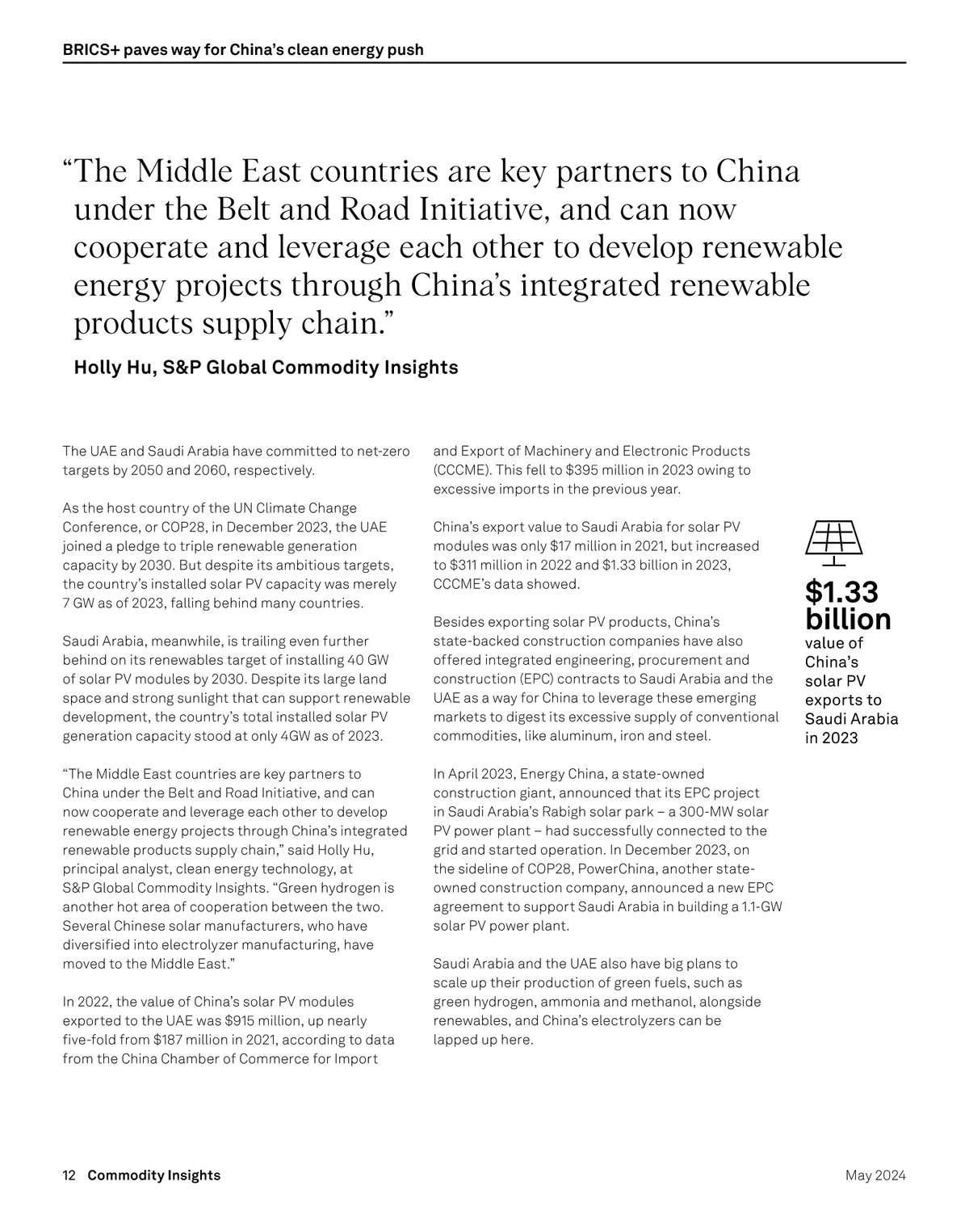
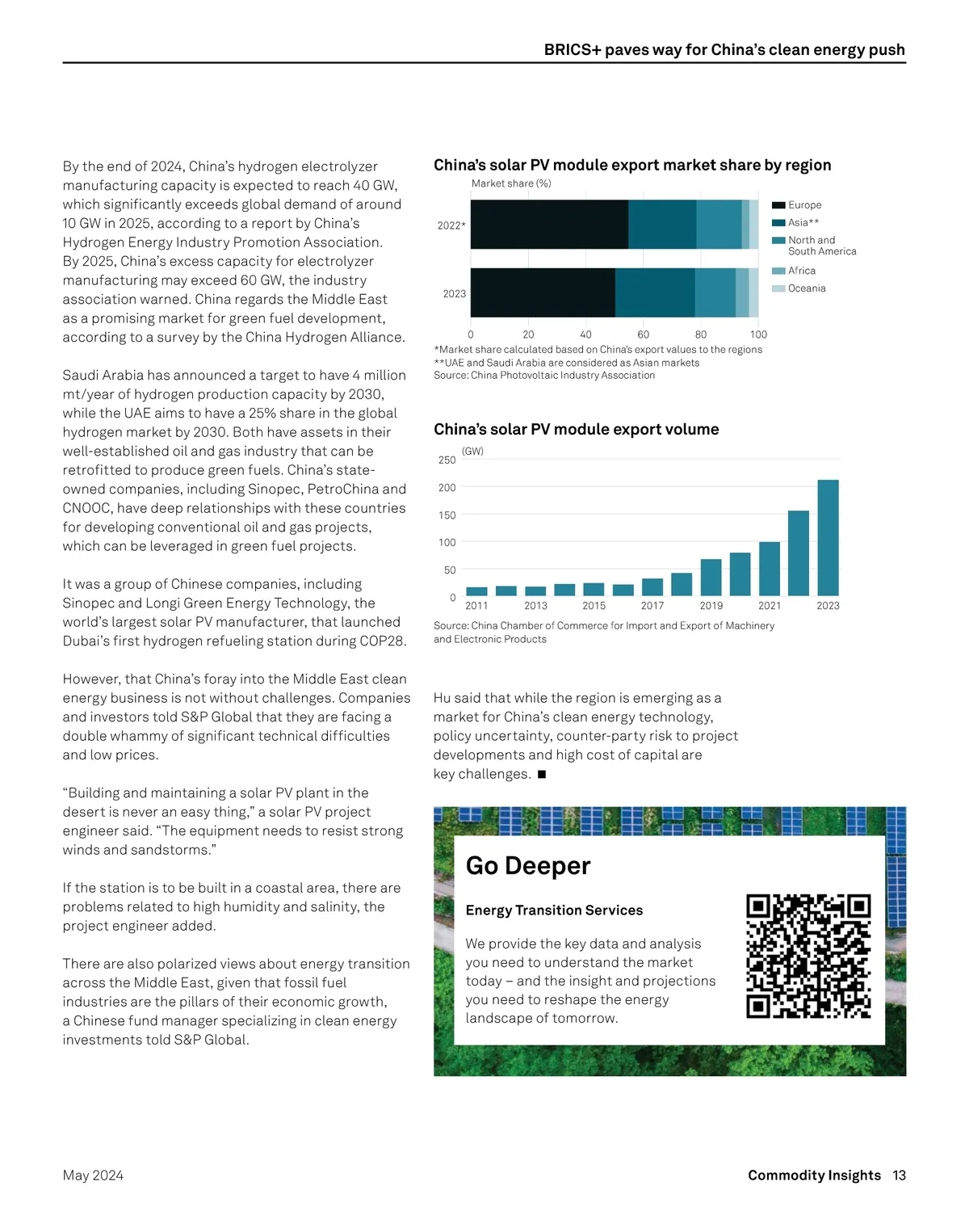
BRICS+ paves way for China’s clean energy push “The Middle East countries are key partners to China under the Belt and Road Initiative, and can now cooperate and leverage each other to develop renewable energy projects through China’s integrated renewable products supply chain.” Holly Hu, S&P Global Commodity Insights The UAE and Saudi Arabia have committed to net-zero targets by 2050 and 2060, respectively. As the host country of the UN Climate Change Conference, or COP28, in December 2023, the UAE joined a pledge to triple renewable generation capacity by 2030. But despite its ambitious targets, the country’s installed solar PV capacity was merely 7 GW as of 2023, falling behind many countries. Saudi Arabia, meanwhile, is trailing even further behind on its renewables target of installing 40 GW of solar PV modules by 2030. Despite its large land space and strong sunlight that can support renewable development, the country’s total installed solar PV generation capacity stood at only 4GW as of 2023. “The Middle East countries are key partners to China under the Belt and Road Initiative, and can now cooperate and leverage each other to develop renewable energy projects through China’s integrated renewable products supply chain,” said Holly Hu, principal analyst, clean energy technology, at S&P Global Commodity Insights. “Green hydrogen is another hot area of cooperation between the two. Several Chinese solar manufacturers, who have diversified into electrolyzer manufacturing, have moved to the Middle East.” In 2022, the value of China’s solar PV modules exported to the UAE was $915 million, up nearly five-fold from $187 million in 2021, according to data from the China Chamber of Commerce for Import and Export of Machinery and Electronic Products (CCCME). This fell to $395 million in 2023 owing to excessive imports in the previous year. China’s export value to Saudi Arabia for solar PV modules was only $17 million in 2021, but increased to $311 million in 2022 and $1.33 billion in 2023, CCCME’s data showed. Besides exporting solar PV products, China’s state-backed construction companies have also offered integrated engineering, procurement and construction (EPC) contracts to Saudi Arabia and the UAE as a way for China to leverage these emerging markets to digest its excessive supply of conventional commodities, like aluminum, iron and steel. In April 2023, Energy China, a state-owned construction giant, announced that its EPC project in Saudi Arabia’s Rabigh solar park – a 300-MW solar PV power plant – had successfully connected to the grid and started operation. In December 2023, on the sideline of COP28, PowerChina, another state-owned construction company, announced a new EPC agreement to support Saudi Arabia in building a 1.1-GW solar PV power plant. Saudi Arabia and the UAE also have big plans to scale up their production of green fuels, such as green hydrogen, ammonia and methanol, alongside renewables, and China’s electrolyzers can be lapped up here. $1.33 billion value of China’s solar PV exports to Saudi Arabia in 2023 12 Commodity Insights May 2024
Commodity Insights Conventional and new energy in focus: Page 12